

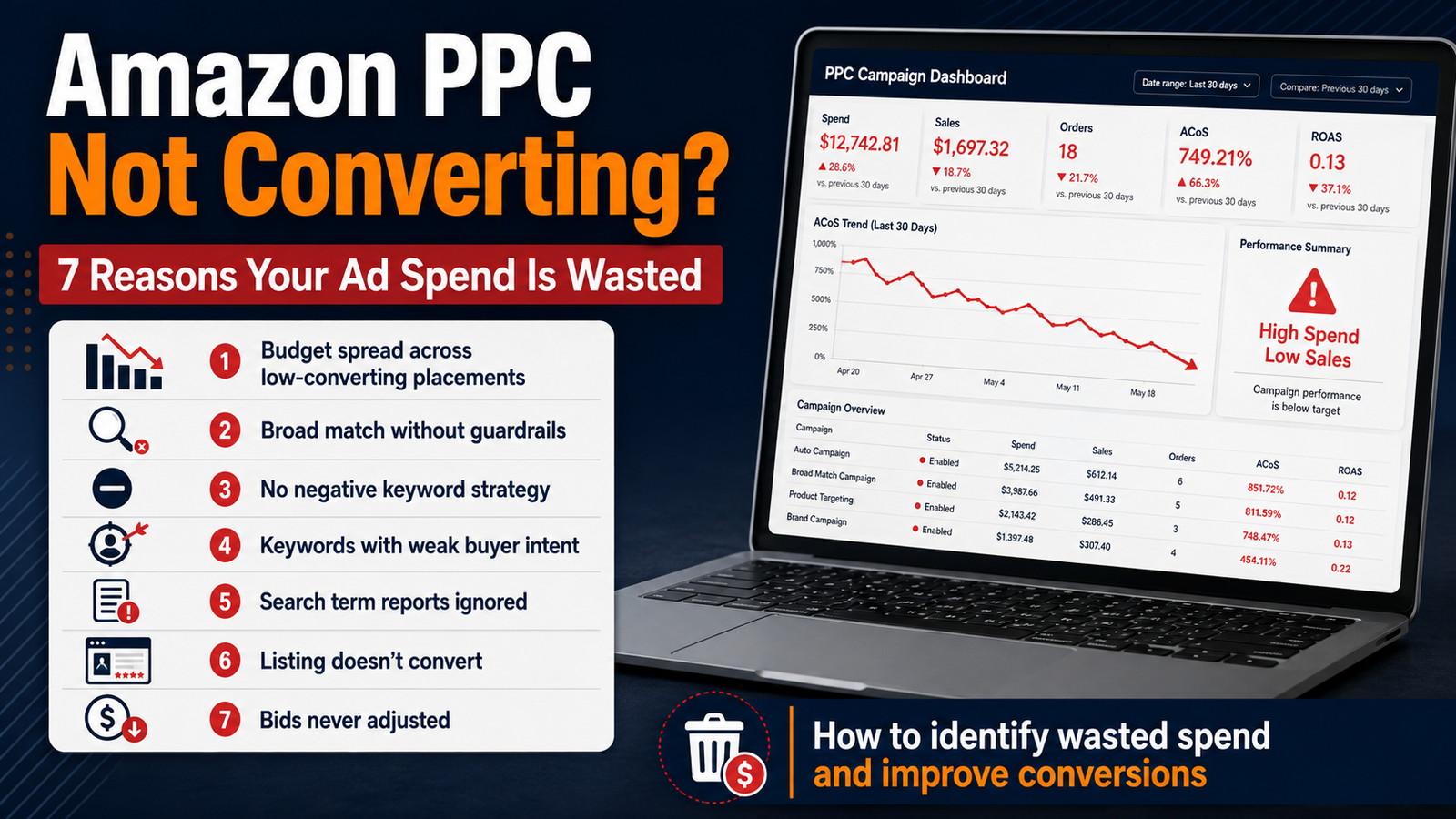
If your Amazon PPC campaigns are burning through budget without the sales to show for it, the problem usually isn’t your product or your niche. When we run an Amazon PPC audit on an account with wasted ad spend, the cause is almost always something specific and fixable, buried in how the campaigns are actually structured and managed, not something wrong with the offer itself.
Here are the seven most common reasons your Amazon PPC isn’t converting, in the order we typically find them.
1. Budget Is Spread Across Placements That Don’t Convert the Same Way
This is the single biggest driver of wasted spend we see, and it’s rarely on anyone’s radar until someone actually breaks the numbers down by placement.
Sponsored products spend splits across a few different placements: top of search, rest of search, and product detail pages. These placements do not convert equally, and treating them as one pool of budget is where the money disappears.
On one account we audited, we found close to $30,000 a month in ad spend landing on Product Detail Page and Rest of Search placements, where conversion was noticeably weaker than what the same keywords were producing at Top of Search. The campaigns were technically “working”; impressions and clicks looked fine, but a huge share of the budget was going toward placements that were far less likely to actually turn into a sale.
Once we identified the gap, we shifted the bid strategy to push more budget toward the top of search, where conversion was strongest, and pulled back on the placements that were quietly eating spend without producing results. The account’s overall conversion efficiency improved noticeably once the budget was actually going where it converted, not just where it was easiest to spend.
If you’ve never looked at your placement report broken out this way, this is usually the first place to check before touching anything else.
2. Broad Match Keywords Without Enough Guardrails
Broad match can work, but it also gives Amazon the most room to match your ad to loosely related searches. Without tight negative keyword lists layered on top, broad match campaigns tend to accumulate clicks from searches that were never going to convert.
3. No Negative Keyword Strategy
This is related to the point above but deserves its own line. If you’re not regularly pulling your Search Term Report and adding irrelevant or underperforming terms as negatives, you’re paying for the same wasted clicks over and over, month after month.
4. Bidding on Keywords That Don’t Match Buyer Intent
Ranking for a keyword isn’t the same as ranking for a keyword someone is ready to buy on. Broad, top-of-funnel search terms often generate volume and clicks without matching the intent of someone close to purchasing. A smaller list of tightly relevant, high-intent keywords usually outperforms a large list of loosely relevant ones.
5. Search Term Reports Get Ignored for Weeks or Months
Even a well-built campaign degrades if nobody is checking in. Amazon’s own search behavior shifts, competitors change their bids, and new irrelevant search terms creep in constantly. An account that isn’t reviewed at least weekly is, by definition, running partly on outdated assumptions.
6. The Listing Itself Isn’t Built to Convert Once the Click Happens
PPC can only do half the job. If the click lands on a listing with weak images, thin bullet copy, or a low review count relative to competitors, even a perfectly targeted Amazon PPC ad will convert poorly. Before assuming a campaign is the problem, it’s worth checking whether the listing conversion rate itself is competitive for the category.
7. Bids Are Set Once and Never Adjusted
A “set it and forget it” bid strategy misses shifts in competition, seasonality, and day-of-week performance differences. Static bids that made sense three months ago are often quietly overpaying or underbidding today.
How to Start Fixing This
- Pull your Placement Report and check how spend and conversion break down across Top of Search, Rest of Search, and Product Detail Pages.
- Pull your Search Term Report and identify terms with high spend and low or no conversions.
- Add those terms as negatives at the campaign or ad group level.
- Adjust placement bid modifiers to push more budget toward whichever placement is actually converting for your specific keywords; this varies by account and shouldn’t be assumed.
- Set a recurring weekly check-in, even 20-30 minutes, rather than letting campaigns run untouched for a month at a time.
Frequently asked questions
What’s a Good ACOS for Amazon PPC?
There’s no universal target since it depends heavily on your margins and category. A better question than “what ACOS is good” is whether your TACOS (total advertising cost of sale, measured against total revenue, not just ad-attributed revenue) is trending in a healthy direction over time.
Should I Turn Off Underperforming Campaigns Entirely?
Not always. Sometimes the issue isn’t the keywords themselves but where the budget is landing within the campaign. Before pausing a campaign entirely, check placement and search term data first. Often the fix is reallocation, not elimination.
How Often Should I Check My PPC Campaigns?
At minimum weekly. Search term data and placement performance shift often enough that monthly reviews alone let inefficiencies build up for weeks before anyone notices.
Stop Wasting Your Amazon Ad Spend
AMZOS is the best Amazon PPC agency that manages ongoing Amazon PPC campaigns for brands and agencies to find exactly where spend is being wasted. If your ad spend doesn’t seem to be converting, talk to an Amazon Suspension Expert, and we’ll take a look at your account.
[…] Misallocating spend across placements. Budget sitting in low-converting placements instead of the top of the search is one of the most common and most fixable sources of wasted PPC spend. […]